
Some songs are born with the scent of summer, crowded streets, and future memories. “Lenço” by João Só and Tiago Nogueira enters this territory with a rare naturalness: it seems light on first listen, but leaves room for deeper interpretations, linked to Portuguese popular imagination, dance, and the encounter between two voices that know very well how to make a song breathe.
As a very recent release, public information is still relatively short and is mainly concentrated on presentation notes for the single and the joint project. Even so, what is already known is enough to understand one important thing: this is not just another occasional collaboration. “Lenço” reinforces a unique musical identity, based on a very Portuguese relationship between celebration, intimacy, and a memorable melody.
Context of "Lenço"'s release and the song's place in the joint project
"Lenço" was released on April 30, 2026, and emerged as the third original from the partnership between João Só and Tiago Nogueira, following "Maldita a Hora" and "Quem Não Sabe Amar". This is relevant because it shows continuity. It is not a one-off meeting, but a work that gains form and language as it progresses.
The duo had already been building its own space, both on stage and in the studio, and "Lenço" appears at a moment when this complicity seems clearer. The song is presented as an advance for the duo's debut album, which also gives it a weight of affirmation: it helps to show the public the emotional and sonic universe that the two want to inhabit together.
There is also a decisive cultural factor. The official description links “Lenço” to the popular summer festivals in Portugal, to streets transformed into dance floors, to heat, laughter, brief romance, and the smell of sardines. This framework is not merely decorative scenery. It functions as an emotional starting point and as a recognizable language for those who know the arraiais (street parties), popular saints' festivals, and the very particular energy of neighborhood nights.
This framework gives the song immediate strength. Instead of seeking an abstract concept, "Lenço" takes a concrete, physical, lived environment and transforms it into pop music with a local accent.
Sound of "Lenço": luminous pop with popular memory
One of the most interesting aspects of "Lenço" lies in the encounter between tradition and the present. The available information highlights the crossover between traditional accordion and a luminous pop energy. This combination alone says a lot about the track's ambition: it does not want to reproduce the past as a museum piece, nor erase popular references in the name of generic production.
It wants to make both worlds coexist.
It is precisely there that the song gains personality. The accordion evokes a collective Portuguese memory, linked to the street, to celebration, to dance, and to closeness. The luminous pop opens the theme, makes it more direct, more singable, and more suitable for circulating between individual listening and live performance. When this fusion works, the music does not sound trapped in a genre. It sounds alive.
The best way to interpret this sound is perhaps as follows:
- festive rhythm
- chorus vocation
- popular color
- melodic accessibility
- summer atmosphere
Many recent Portuguese songs approach the popular repertoire without falling into folkloric reconstruction. “Lenço” fits well into this line, but does so with an important difference: the duo seems to use this material not as a stylistic effect, but as an affective language. Tradition, here, does not appear as an ornament. It emerges as a form of communication.
Central elements of "Lenço" at a glance
The factual information and critical reading of the song can be organized simply.
| Element | What is already known | Most likely interpretation |
|---|---|---|
| Release date | April 30, 2026 | Marks a new step in the joint project |
| Place in the duo's discography | Third original | Consolidation of a shared identity |
| Song's atmosphere | Popular summer festivals in Portugal | Street, dance, encounter, and conviviality |
| Sound | Traditional accordion and pop energy | Fusion of popular memory and contemporary language |
| Suggested themes | Proximity, warmth, fleeting romance | Brief, intense, and collective emotion |
| Symbol of the title | No detailed public authorial explanation | Object of gesture, invitation, and memory |
This table helps separate what is confirmed from what still belongs to the realm of interpretation. And this care is useful, because “Lenço” is recent and there isn't yet a large number of interviews or extensive critical analysis on the subject.
Even so, the song already shows clear signs. And they are strong signs.
The symbol of the handkerchief in the song and in Portuguese imagination
The title deserves special attention. There is no widely disseminated authorial explanation, as of yet, regarding the exact reason for choosing the word "lenço" (handkerchief). This prevents closed interpretations, but does not diminish the richness of the symbol.
On the contrary.
In the Portuguese imagination, the handkerchief can be many things at once: a gesture, an adornment, a wave, an invitation, a sign of affection, an object for dance, a trace of a presence. In a festive context, it gains even more life. A handkerchief can be waved in the air, kept in a pocket, tied to the body, lent for a moment. It is a small object, but heavily laden with humanity.
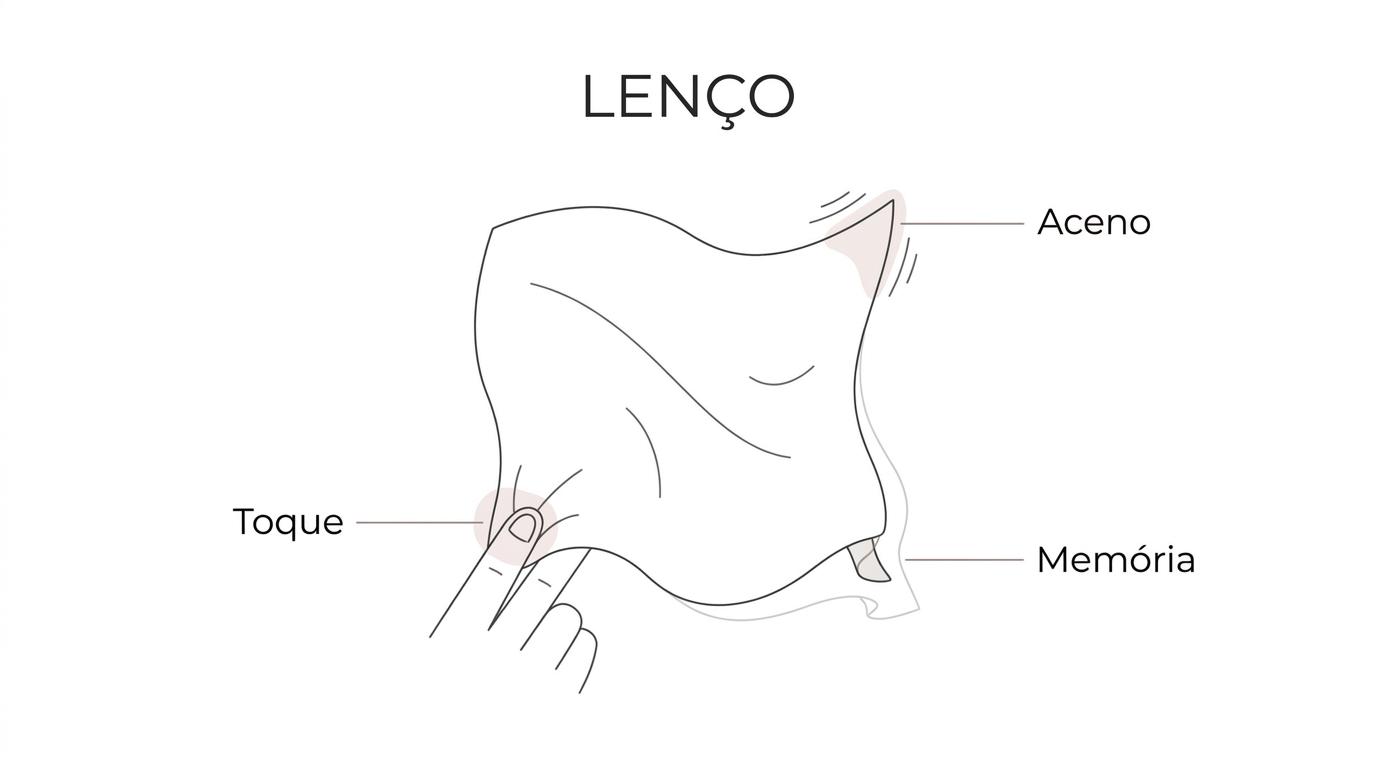
It is also a very intelligent title because it avoids excess. Instead of directly naming love, celebration, or saudade, the song chooses a material detail. This detail opens up an entire world.
After considering the context of the track, the symbol can be read on several levels:
- Gesture and signal: the handkerchief functions as an extension of the body, almost like a language without words.
- Intimate object: it is close to the skin, the hand, the touch.
- Popular mark: refers to a visual and affective heritage that is easily recognizable.
- Trace of memory: it remains as a remnant of a night that passed quickly.
This reading gains strength because "Lenço" seems to speak precisely of short, striking moments. If there is fleeting romance, dancing in the street, and summer heat, then the handkerchief can be what condenses all of this into a single object: the sign of an encounter and, at the same time, proof that it existed.
João Só and Tiago Nogueira: why the collaboration makes sense
When two figures with defined paths come together, the result depends less on the sum of names and more on the quality of the fit. In the case of João Só and Tiago Nogueira, this fit seems very natural.
João Só is often associated with versatile writing and consistent work as a composer, performer, and producer. Tiago Nogueira brings a very strong narrative presence, already recognizable from his journey with Os Quatro e Meia. One tends to be read with an emphasis on song construction; the other, with an emphasis on the song's direct communication. Together, these two axes can generate a balance between sophistication and intimacy.
That’s what “Lenço” suggests. The song seems designed to be felt immediately, but without losing formal care. There is lightness, but no superficiality.
The partnership stands out for some very clear points:
- Artistic complementarity: a union between refined writing and narrative ability.
- Vocal complicity: two voices that don't compete, but rather create space for each other.
- Stage vocation: music designed to work live and in community.
- Relationship with popular song: openness to diverse repertoires without stylistic rigidity.
It is also important to consider the broader context of the project. The duo has been presented as the result of a shared appreciation for song in a broad sense, without rigid boundaries between references. This helps explain why "Lenço" manages to sound Portuguese without sounding programmatic, and popular without losing its freshness.
Emotional themes of "Lenço" and connection with the public
Without the full lyrics widely available in open source, thematic analysis must start from the official description of the track and what the concept itself suggests. Even so, there are several very clear lines.
The first is the encounter. “Lenço” seems to be born from that moment when public space stops being just a thoroughfare and becomes a possibility. In popular festivals, the street changes its function. It becomes a place of music, dance, rapprochement, and chance. This gives the song a very strong emotional basis, because the encounter here is not abstract. It has scenery, temperature, smell, and body.
The second line is fleeting romance. The expression was used in the single's presentation and is worth dwelling on for a bit. Not all romantic songs need to promise longevity. Some prefer to celebrate the moment, and that gesture can be even more genuine. In “Lenço,” the ephemeral seems to have its own value. Not as a loss, but as intensity.
Other layers also stand out:
- proximity
- human warmth
- collective celebration
- sensory memory
- brief tenderness
There's also a very interesting trait: the song seems capable of producing nostalgia almost at the same time it produces joy. This mixture is a powerful signature in Portuguese popular music. A night can be happy and wistful simultaneously. A dance can be present and memory in the making. "Lenço" seems to move precisely in that interval.
"Lenço" as a Portuguese summer song with lasting ambition
Many songs linked to summer only live off the atmosphere. "Lenço" shows signs of wanting more than that. Its universe is clearly seasonal, yes, but the emotional content can last beyond the season. This happens when a song finds a strong image, an accessible melody, and a collective context that the public recognizes as its own.
The festive street is one of those strong images. In Portugal, the arraiais (street parties) and popular nights continue to be a privileged place for social interaction, for mixing generations, and for creating small common memories. When a song manages to enter this affective archive, it gains a chance of permanence.
That is why “Lenço” seems interesting not only as a new single, but as part of a repertoire that can grow significantly on stage. There are songs that are listened to. Others demand audience voices, clapping, a shared chorus. Everything indicates that this one belongs to the second group.
And perhaps that is its greatest merit so far: transforming a simple element of Portuguese popular culture into an open, luminous song with room to continue growing as it is sung, danced, and appropriated by those who listen to it.
If the joint project of João Só and Tiago Nogueira already promised its own identity, "Lenço" is a very convincing step in that direction. It is a song that looks at tradition without excessive weight, treats encounters with delicacy, and finds in the Portuguese summer not just a beautiful setting, but true poetic material.


